


Comprehensive security architecture and deterministic real-time performance.
Platform → Overview | Architecture | Technology | Security | FrameworX | Editions
Designed for Reliable Performance and Enterprise Security
FrameworX combines deterministic real-time performance with comprehensive security architecture. Built on the Technology Foundation of 100% managed .NET code, the platform delivers millisecond response times while maintaining defense-in-depth protection and full compliance capabilities.
Operational Excellence:
- Performance monitoring with <100ms tag updates & 1ms timestamps
- Multi-layer security with RBAC, Secrets and encryption
- Supports FDA 21 CFR Part 11, IEC 62443 and NERC-CIP compliance programs (not third-party certified)
- Git-based DevOps with JSON export
- Hot-standby redundancy with <5 second failover
Optimized Architecture
Optimization Layers
| Layer | Optimization | Impact |
|---|---|---|
| Application | Efficient scripts, optimized queries | CPU usage |
| Runtime | Thread pool tuning, memory management | Response time |
| Database | Indexing, partitioning, archiving | Query speed |
| Network | Compression, protocol selection | Bandwidth |
| Hardware | CPU cores, RAM, SSD storage | Overall capacity |
Performance Metrics
| Metric | Target | Measurement |
|---|---|---|
| Tag Update Rate | <100ms | Device to display. Test case: 100,000 Modbus tags in < 1s |
| Alarm Response | <1 second | Condition to notification, keeping 1ms timestamp on logs |
| Client Response | <200ms | User display action to feedback |
| Displays Update | < 50ms | Code behind execution and realtime updates on diaplays |
| Historian Write | <1 second | Tag change to storage, keeping 1ms timestamp on logs |
| Failover Time | <5 seconds | Primary to standby |
(*) Those are expected numbers in a typical implementation. Exact metrics depending on solution design and hardware
Built-in Performance Monitoring Tools:
- Real-time performance dashboards
- Resource utilization tracking
- Bottleneck identification
- Historical trend analysis
Operational Stability
- 100% Managed Code - No memory leaks or pointer errors
- Exception Handling - Graceful failure recovery at every level
- Multi-threaded Execution - Parallel processing with thread safety
- Resource Management - Automatic garbage collection and optimization
Performance Under Extreme Conditions
The figures above describe steady state operation. An industrial system is judged on how it behaves when conditions are not normal. This section states the expected behaviour under abnormal load and the limits that apply.
Scenario |
Mechanism |
Expected behaviour |
|---|---|---|
Event storm, large volume of simultaneous status changes |
Send by exception, multi threaded module execution, event driven architecture |
Events are queued and processed in order. Acquisition and logging continue at full rate. Display refresh is the first thing to lag, not data capture |
Alarm flood |
Deadbands with time and value hysteresis, priority levels, area filtering, grouping, shelving |
Every alarm transition is recorded with its 1 ms timestamp. Nuisance repetition is suppressed at the source rather than by discarding records. The operator view stays usable through priority and area filtering |
Communication failure |
Store and forward buffering on alarms and historian, edge autonomy |
Edge and server nodes continue acquiring and buffering locally. No records are discarded while buffer capacity remains |
Communication recovery |
Automatic resynchronisation, buffered forward on reconnect |
Buffered records are forwarded with their original timestamps, not the timestamps of the recovery. Time series and alarm history close without a gap |
Sustained high load and growth |
100% managed code, graceful exception handling at every level, automatic resource management |
No memory leaks or pointer faults. A failure in one module is contained and does not propagate to the runtime |
Guarantees under abnormal conditions
Within the documented limits below, extreme conditions do not cause:
- loss of acquired data
- loss of event sequence integrity, since records carry a 1 ms timestamp applied at capture
- interruption of monitoring, control, alarming or logging
- loss of communication with connected systems
Documented limits
- Sustained event and alarm rates depend on hardware sizing, channel count and solution design. Figures for a specific configuration are established during system sizing and validated at factory and site acceptance testing.
- Store and forward capacity is bounded by the storage allocated to the buffer. Buffer sizing is a system design decision and must be matched to the longest outage the deployment must survive without loss.
- Under a severe flood, operator display refresh degrades before data acquisition or logging. This is deliberate: the presentation layer yields so that the data layer does not.
- Duplicated acquisition in a Hot-Hot deployment increases device network load and can produce timestamp differences between the two servers. Hot-Standby does not have this characteristic.
Security Architecture
Defense in Depth Implementation
| Layer | Protection Level | Components |
|---|---|---|
Layer 1: Network. Security | Perimeter defense |
|
Layer 2: Application Security | Access control |
|
Layer 3: Data Security | Information security |
|
Layer 4: Operational Security | Process integrity |
|
Security Zones Architecture (ISA-99/IEC 62443)
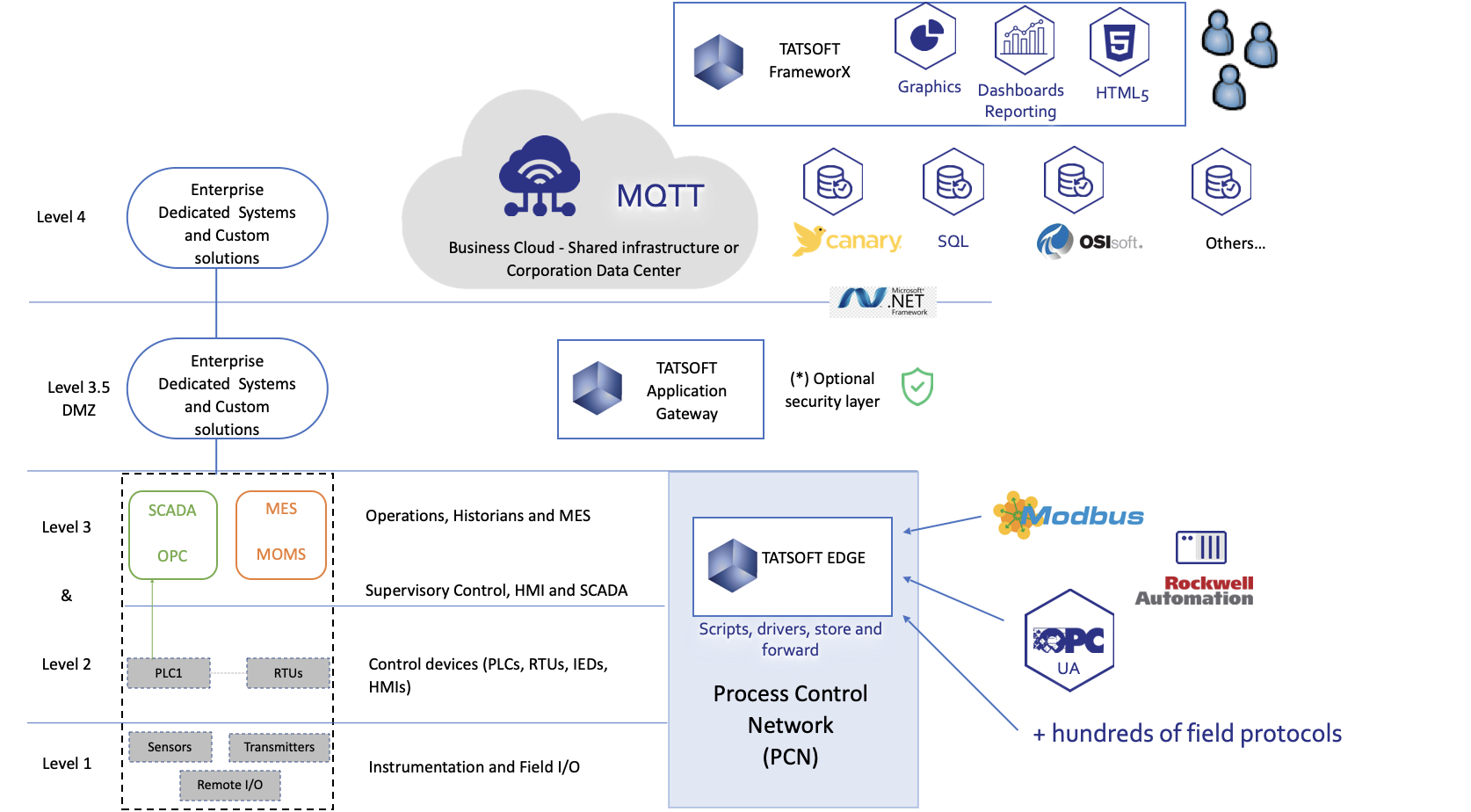
TSecureGateway enables secure data transfer across zones, bridging Level 2 (factory floor) to Level 4 (enterprise) while maintaining isolation and protection against threats.
Authentication & Authorization
Flexible Authentication Methods
| Enterprise Integration | Native Options |
|---|---|
|
|
Role-Based Access Control (RBAC)
- Granular Permissions - Display, object, and action-level control
- Group Hierarchies - Inherited permissions with override capability
- Dynamic Roles - Runtime permission changes based on context
- User Policies - Password complexity, session duration, auto-logoff
Compliance & Standards
Industry Standards Implementation
| Standard | Implementation | Key Features |
|---|---|---|
| ISA-95 | UNS design patterns | Enterprise/control integration model |
| ISA-101 | HMI design compliance | Operator effectiveness standards |
| FDA 21 CFR Part 11 | Electronic records/signatures | Audit trails, data integrity, validation |
| High Performance HMI | Display design principles | Situational awareness, alarm management |
| IEC 62443 | Cybersecurity guidelines | Security zones, defense in depth |
| NERC-CIP | Critical infrastructure | Access control, monitoring, recovery |
DevOps & Version Control
Enterprise Development Practices
| Native Tool | Feature |
|---|---|
| JSON-Git Export | Human-readable diffs for Git integration |
| Change Tracking | Keep track of changes at object level, with automated version numbering |
| Cross Reference | Dependency analysis and automated rename for all configuration objects |
| Build Procedure | Validation of all server scripts and all displays scripts |
| Publish Procedure | Readonly deployment files for regulated areas |
| Execution Profiles | Management for Development, Validation, Production and Custom environments — a single .dbsln can run all four profiles concurrently on distinct ports, each isolated and managed independently. |
| DevOps APIs | Programmatic control of configuration and execution |
| Health Monitoring | Built-in runtime metrics and web dashboard. TServer /health and /ready (port 3101) for Kubernetes liveness/readiness; TWebServices /health (port 10108) for Solution Center health. |
| REST API | Data-plane on TServer (port 3101+, Bearer-GUID) for tag values, aggregates, and alarm state; management-plane on TWebServices (port 10108, JWT/OIDC) for Solution Center operations. |
| Container Support | Docker deployment including support for App Hosting in Cisco Routers |
| Execution Integrity | Built-in diagnostics to verify if running solution matches a given configuration. |
Solution Configuration Protection
- Encrypted Configuration - All settings in protected .dbsln file
- IP Protection - Source code and binaries secured
- Single File Deployment - Simplified distribution and management
- Access Control - Role-based modification rights
Redundancy & High Availability
Hot-Standby Configuration
| Feature | Specification | Benefit |
|---|---|---|
| Automatic Failover | <5 seconds switchover | Minimal disruption |
| Data Synchronization | <5 seconds switchover | No data loss |
| Client Reconnection | Transparent to operators | Continuous operation |
| State Preservation | Full context maintained | Seamless recovery |
(*) Those are expected numbers in a typical implementation. Exact metrics depending on solution design and hardware
Supported Redundancy Modes:
- Server redundancy (primary/standby)
- Database redundancy (mirrored/centralized)
- Network redundancy (dual-path)
- Device redundancy (PLC communication)
External Validation
- Regular third-party penetration testing
- Veracode security assessments
- Gap analysis and remediation
- 100% approval requirement for release
Aim high, start simple, scale without limits.
In this section...