


Enterprise energy management with legacy platform migration and multi-site consolidation.
Industry: Steel Manufacturing
Quick Facts
| Attribute | Value |
|---|---|
Customer | Usiminas Steel: South America's largest steel supplier with 13 industrial plants across Brazil |
| Initial Deployment | 2011-2013 |
| Scale | 100,000+ I/O points, 25+ sub-systems, 100+ displays |
| Architecture | Fault-tolerant redundancy, multi-site Energy Center |
| Status | Running successfully to present day |
Historical Context
This deployment represents a 30-year relationship between customer and the Tatsoft founding team:
| Era | Platform | Relationship |
|---|---|---|
| 1990s | Unitec (DOS) | Initial software supply |
| Late 1990s | UniSoft → InduSoft | Windows migration |
| 2000s | FactoryLink (Siemens/USDATA) | Customer's choice based on European steel industry installed base |
| 2011+ | FactoryStudio (Tatsoft) | Emergency migration after FactoryLink discontinuation |
The Challenge
Challenge: Consolidate multi-site energy operations with heterogeneous equipment and multiple protocols, preserving local autonomy (history, alarms, synoptic) while enabling a unified corporate view (Energy Center), with high availability and point/tag scale.
Specific pain points:
- Integration of multiple vendors and legacy interfaces (OPC DA) in a distributed topology
- Lack of a central view and standardized alarms/history across areas
- Need for redundancy and fault tolerance (servers, network, clients)
Impact: Slow responses to energy events, engineering rework, and higher operational risk due to fragmented data.
Example: "Without a unified central network, the energy team had to manually correlate events and histories across areas, increasing MTTR."
Platform Crisis (2010-2011)
When selecting a platform for their new Energy Center, the customer conducted:
- Technical evaluation (FactoryStudio won)
- Market analysis of European steel plants (FactoryLink had largest installed base)
Decision: Selected Siemens FactoryLink based on installed base — reasoning that technology validated by European steel plants was "safe."
Shortly after commissioning, Siemens announced end-of-support for FactoryLink.
- Siemens offered WinCC migration — but this meant complete restart
- Unacceptable for a system just commissioned
- Customer contacted Tatsoft directly, based on decades of trust
The Solution
Architecture
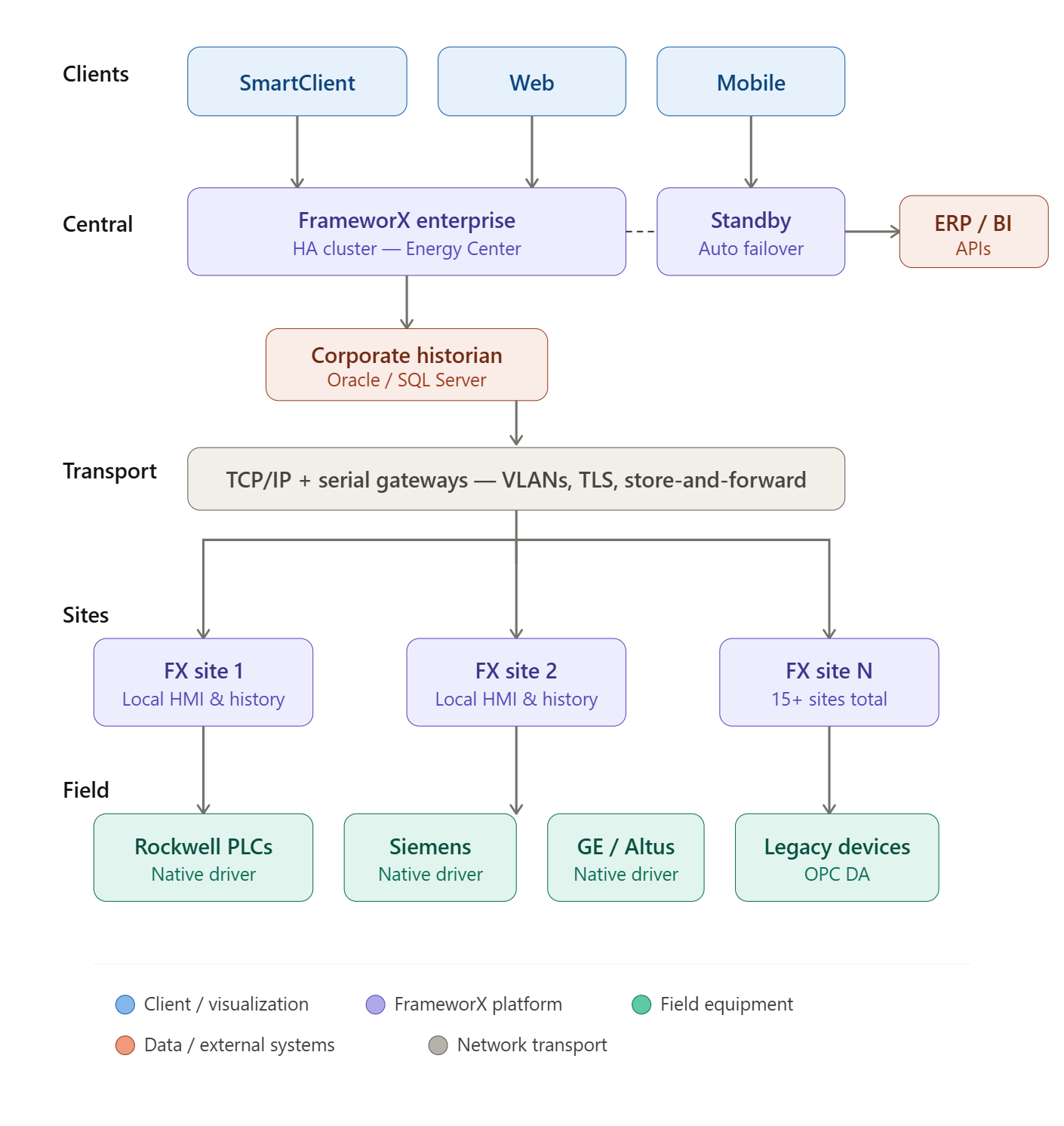
| Tier | Component | Capabilities |
|---|---|---|
| Field (15+ sites) | FrameworX Site | Drivers (Altus, GE, Siemens, Rockwell, OPC DA), History & Alarms, Synoptic displays, Store & Forward, Scripts |
| Central | FrameworX Enterprise | Area Consolidation, Corporate Historian/Alarms, Integrations (OPC/DB/APIs), Redundancy (HA) |
| Clients | SmartClient / Web / Mobile | Operations & Engineering access |
Connectivity
| Vendor | Protocol |
|---|---|
| Rockwell | Native driver |
| Siemens | Native driver |
| GE Fanuc | Native driver |
| Altus | Native driver |
| Reliance | Native driver |
| Legacy devices | OPC DA |
| Databases | Oracle, SQL Server |
Topology
| Layer | Component | Role | Notes |
|---|---|---|---|
| Area | FrameworX Site | Acquisition, history, alarms, HMI | Independent local operation; standardized models |
| Transport | TCP/IP, Serial | Telemetry and control | Network segmentation; QoS; serial/IP gateways |
| Central | FrameworX Enterprise | Consolidation, orchestration, APIs | Cross-area normalization; corporate dashboards |
| Data | Historian/DB | Corporate repository | Retention/partitioning strategy |
| Clients | SmartClient/WebAssembly | Operations & engineering | Multiple concurrent clients |
Network Architecture
- Segmentation by area and VLANs; redundant links where critical; TLS encryption for inter-site traffic
- Gateways for serial↔IP conversion (RS-485/RS-232) and secure tunneling
- Legacy OPC DA gateways/proxies for older equipment
- DB connectors for corporate BI; APIs for ERP/maintenance systems
Redundancy & Failover
Central:
- Cluster/HA for real-time services, history, and alarms
- Database with tested backup/restore procedures
- Automatic failover with zero data loss
Areas:
- Independent operation continues during central outages
- Store-and-forward for network resilience
- Automatic reintegration when connectivity restores
Technical Scope
Energy Center
- Complete plant monitoring for water and energy systems
- Real-time control and optimization
- 25+ water systems with hot-standby configuration
- Advanced optimization algorithms (customer-developed)
Additional Systems (Same Platform)
| System | Migration From | Capability |
|---|---|---|
| Furnace Optimization | ALPHA computer system | Advanced temperature controls |
| Bar Tracking | Custom VB application | Order tracking integration |
All integrated into single FactoryStudio platform.
Key Enablers
FrameworX capabilities that made this solution possible:
| Capability | Application |
|---|---|
| Multi-protocol native drivers | Connected heterogeneous equipment (Rockwell, Siemens, GE, Altus) without middleware |
| Fault-tolerant redundancy | Hot-standby with zero data loss during failover |
| Store-and-forward | Network resilience across distributed sites; automatic reintegration |
| Symbol Library | 200+ displays built efficiently with reusable components |
| Template import | Areas developed independently, merged into master project |
| Shift-based security | Auto-logout, operator-specific permissions per shift |
| Area-based security | operator-specific permissions per location from the logon |
Strategic Insights
Platform Selection vs. Installed Base
This case illustrates a critical lesson: installed base indicates past validation. Platform selection should consider what will best serve the next 10-15 years — which often differs from what dominated the previous 10-20 years.
Migration vs. Restart
When the incumbent platform was discontinued, the customer faced a choice: restart on vendor's new platform (WinCC) or migrate to a platform that had won their original technical evaluation. The ability to migrate rather than restart preserved their investment and timeline.
The Results
- Consolidated 15+ plant operations into single Energy Center managing 100,000+ points
- Eliminated manual event correlation — unified alarms and history reduced MTTR
- Zero data loss during network disruptions via store-and-forward
- 50%+ reduction in development time vs. legacy system (built-in properties and application objects)
- 35 nodes distributed across entire plant with remote client access
- Running successfully since 2013 — over 10 years of continuous operation
Customer Testimonial
"The Tatsoft FactoryStudio software, used in the migration of the Integrated Recirculation Monitoring System at the Ipatinga facility, proved to be stable and reliable, increasing the process efficiency and costs optimization."
— Guilherme Publio Teixeira, Manager of Energy and Utilities Systems Support, Usiminas Ipatinga
Resources
- Usiminas Energy Management Case Study.pdf - Published case study
This case demonstrates enterprise-scale operations center architecture with multi-vendor integration, fault-tolerant redundancy, and distributed site management.
In this section...