


Integrated vessel management with power, cargo, and alarm systems meeting maritime classification. I
Industry: Maritime / Naval
Quick Facts
| Attribute | Value |
|---|---|
| Scale | 5,000-10,000 I/O points |
| PLCs | 8 naval-certified controllers |
| Displays | 30 HMI screens (bridge, engine room, local panels) |
| Protocols | OPC, Modbus over redundant ring topology |
| Systems | Power Management, Alarm Management, Cargo Management |
| Architecture | Distributed redundant system across vessel compartments |
The Challenge
Challenge: Implement unified control for complex naval vessel operations including power generation, hybrid energy sources, cargo management, and alarm systems while meeting strict maritime classification requirements.
Specific pain points:
- Legacy systems lacked integration between power management, cargo handling, and alarm monitoring
- Operational inefficiencies and safety risks from disconnected systems
- No redundant architecture — single point of failure on mission-critical vessel systems
- Non-compliance with maritime classification society requirements
- Inability to coordinate generator control with hybrid battery systems
Impact: Without unified control, vessel operations face safety risks, regulatory non-compliance, inefficient fuel consumption, and cargo transfer errors.
The Solution
Architecture
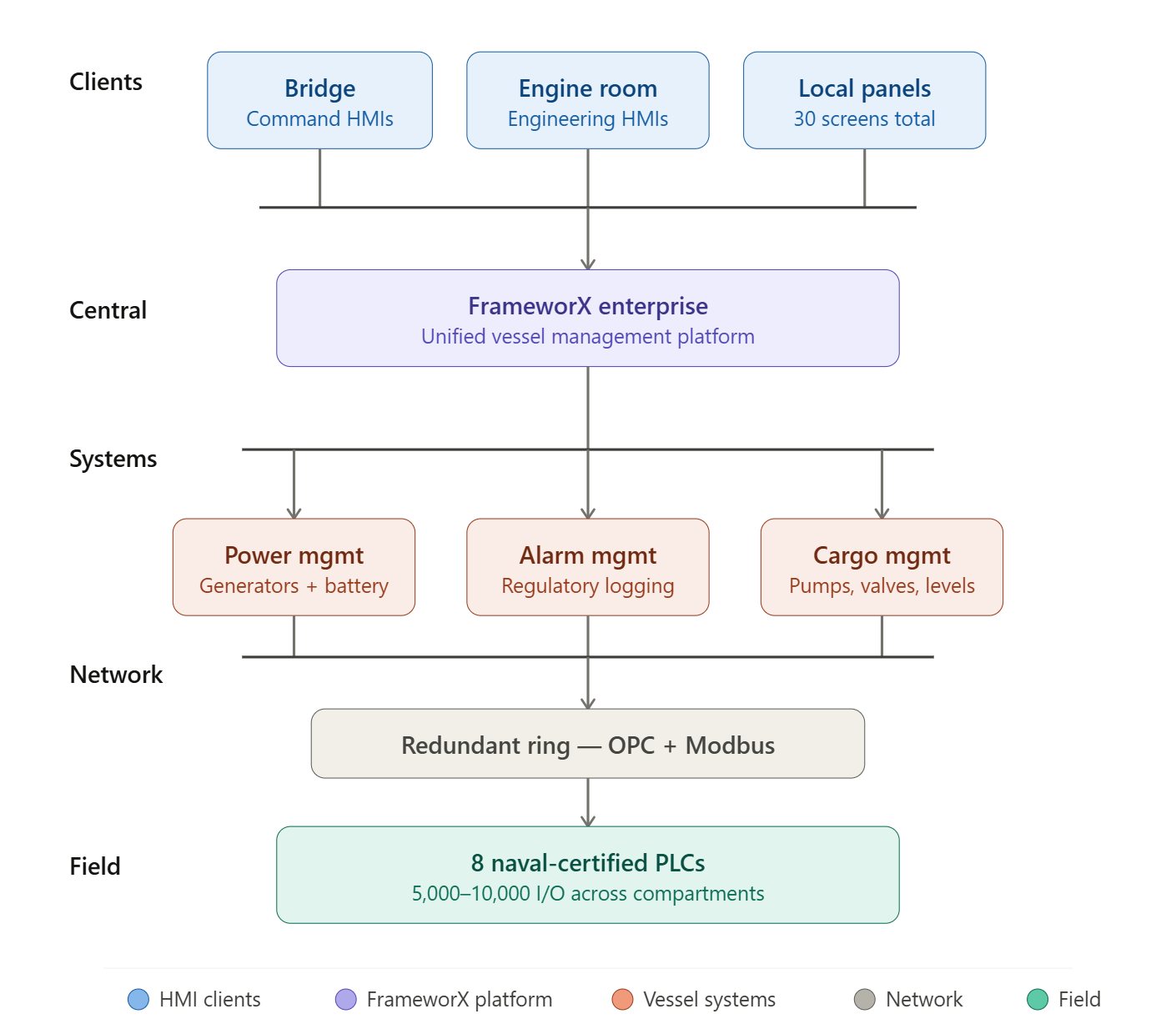
| Tier | Component | Capabilities |
|---|---|---|
| Field | 8 naval-certified PLCs | 5,000-10,000 I/O points across vessel compartments |
| Network | Redundant ring topology | OPC and Modbus protocols, zero single-point-of-failure |
| Central | FrameworX Enterprise | Unified vessel management platform |
| Clients | 30 HMI screens | Bridge, engine room, local control panels |
Integrated Systems
| System | Function |
|---|---|
| Power Management (PMS) | Generator control, load protection, hybrid battery integration |
| Alarm Management | Centralized monitoring and regulatory alarm logging |
| Cargo Management | Vacuum/liquid pumps, valves, level monitoring, volume calculations |
Materials Handled
- Potable water
- Diesel
- Cement
- Gravel
- Bulk dry goods
Connectivity
| Protocol | Application |
|---|---|
| OPC | System integration |
| Modbus | Field device communication |
| Redundant Ring | Network topology for fault tolerance |
Key Enablers
FrameworX capabilities that made this solution possible:
| Capability | Application |
|---|---|
| Naval Classification Compliance | All components certified to maritime standards |
| Hybrid Power Management | Seamless integration of generators and battery banks with automatic load balancing |
| Comprehensive Cargo Control | Unified management of liquid and dry bulk materials with volume calculations |
| Redundant Ring Architecture | Zero single-point-of-failure design for continuous operation at sea |
| Multi-Location Control | Synchronized operation from bridge, engine room, and local stations |
| Regulatory Alarm Logging | Complete alarm recording meeting naval vessel requirements |
The Results
100% Classification Compliance — Achieved full compliance with naval classification society requirements
20% Fuel Reduction — Reduced fuel consumption through optimized hybrid power management
Zero Cargo Errors — Eliminated cargo transfer errors with automated volume tracking and valve control
65% Faster Alarm Response — Decreased alarm response time with centralized monitoring and logging
Remote Bridge Monitoring — Enabled monitoring of all vessel systems from bridge, improving operational safety
Fault-Tolerant Operation — Delivered full redundancy across 5,000-10,000 control points
Unified Crew Operations — Streamlined operations with unified control across 30 HMI screens
This case demonstrates naval vessel control system integration with maritime classification compliance, hybrid power management, and redundant architecture for mission-critical operations at sea.